
I just returned from an eye-opening interactive event called “Welcoming the Stranger: What’s at Risk?” as part of the annual Spirit and Place festival here in Indianapolis. I got to experience what it might be like to be a recently relocated immigrant to a city where I had few resources and did not speak the dominant language. About 80 of us participated in the activity which lasted 2 hours. Many were assigned individuals to role play. Some were children as young as two years old, others school age. Then there were adults, some with jobs, others without. Many were undocumented immigrants with limited English proficiency.
I was asked to sit at a table and “be the church” in the neighborhood. I was given some money and food/clothing vouchers and a page full of guidelines and rules. The church ran a homeless shelter, but the shelter also had many rules and guidelines I was supposed to follow. My guidelines instructed that no family could stay in the shelter for more than 2 weeks. There were limitations on the amount of money I was supposed to give to any individual, and I was supposed to document in a ledger all the referrals to other agencies I made.
I learned that people often have different needs than helping institutions assume are the priority.
It was an awesome experience. I learned that I had more money in my coffers than the guidelines said I would have, so I took that as a sign that the church had recently had a huge fundraiser to support our community outreach efforts. I gave out freely without regard to the rules. Based on the missional concept that the “church” is not confined to the four walls of the building, I also made weekly trips to the “jail” to visit with folks who had been detained for a variety of non-violent offenses mainly due to language barriers. I was even able to bail some of them out and get others work (if they didn’t have a green card, I employed them at the church and paid them under the table).
What I learned was even though we had lots of resources to give out, I ended up with left over vouchers and petty cash at the end of the simulation. People needed me to help them find where to go to get things done much more often. They needed help navigating the rest of the system. Where to buy food, where to take their kids to day care, how to apply for disability, go to school, etc. Each of those stations existed in the simulation space, but they were labeled in different languages that not many of us spoke (e.g., Croatian, Hungarian, etc).
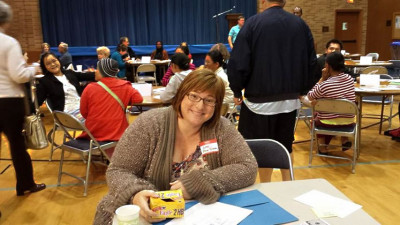
“Could you be the church?” The invitation I accepted as part of the simulation of “Welcoming the Stranger” I participated in last Sunday.
At the beginning of the exercise, when the families were all still in their homes (i.e., chairs set up in groups of four in the center of the room), I took the opportunity to go around to all of the agencies in the neighborhood (i.e., tables set up on the perimeter of the room) to try to figure out what role each played in the community. I went back to the church and drew a map of the room so I could make better referrals. I then took the “rules and guidelines” sheet and drew a bunch of religious symbols on the back of it — Hindu, Muslim, Tao, Christian, Jewish, Buddhist, etc. I wanted folks to know where the church was in town, since my station was labeled in a language very few people in the room would understand. I hoped the symbols would help. I held up my sign so people would know where to come for help.
I learned that people often have different needs than helping institutions assume are the priority. I expected people to come for the stuff I had to offer: the money and the food / clothing. But it worked out differently. In the first few minutes very few people voluntarily approached the church. And when they did, they would hesitate to ask for help directly. And they expected that there was some quid pro quo involved, like we would make them join the church in order to get services. I told them they were welcome to come to services on Sunday if they liked, but it was not necessary.
I learned that a handshake and a smile go a long way to breaking the ice and can take desperate people quite off guard. I also learned that there is simply a dizzying amount of legal documents that immigrants need to navigate and that I, as a native speaker, even could not decipher. Eventually even the windfall of resources the church had in its folder started to run short. Two different families came to ask for help each with a similar problem: one adult member could not find work because of they did not have the money to pay the legal services to file the application for a work permit. I had neither the money nor the expertise to help them fill out the paperwork or properly file it. It was an awful feeling. Compounding the sense of helplessness, I was working with a nine-year-old interpreter for a father who could not speak the same language I was speaking. I was basically turning away a nine year old.
Our mission field just showed up at our door. We could embrace it or reject it, and we chose to embrace it. ~George Robinson
It was very good to experience this with so many others. We debriefed the exercise afterward. At our table, we had a couple of folks who were children of immigrants and lived through many of the experiences we got a taste of in the simulation. They testified to the realities reflected in the simulation. Their stories were powerful.
The church that hosted the event, First Baptist, not 15 minutes from my house, has become a second home to a large population of Burmese refugees in the last 6 years. They describe it as a church within a church where the immigrant families hold their own services and sometimes have twice as many people in attendance than the original congregation.
“Our mission field just showed up at our door. We could embrace it or reject it, and we chose to embrace it.”George Robinson, Director of First Baptist Athletics
Talk about a mission having a church! Would that we all could follow such an courageous example.
To help their congregation understand the new reality they live in, both the long-term members and the newer ones, First Baptist helped establish and provides office space for a new community organization. For more information, visit the Burmese Community Education Center.
The transformational work the folks at First Baptist are doing is truly inspiring.
Photo Credit: jonathanpercy (flickr)
Pingback: Immigration Simulation Experience | INDYthinks